Quarkus Panache Swagger Blueprint
2026
Starter Template
Open Source • Backend Template • Microservice • Database Wrapper • Cheatsheet • REST API • Java • Hibernate • JPA • Quarkus • Swagger • OpenAPI



Overview
Quarkus REST Data Panache promises zero-code CRUD endpoints. In practice, the generated API often silently misbehaves the moment your entities have real relationships, lazy-loaded relations that trigger N+1 queries, shared primary keys that break insert and delete, Swagger schemas that document status codes the API never actually returns.
This template sits in the gap between “disposable demo” and “rewrite everything yourself.” It leverages the rapid prototyping speed of PanacheEntityResource while documenting exactly where and why the generated code needs to be supplemented, and provides working, copy-rename-ready patterns for each of those cases.
The scope is intentionally narrow: a database wrapper microservice, a service that owns a small set of tables and exposes them over REST for other internal services to consume, without carrying significant business logic.
What This Template Covers
- JPA relation mapping done right, concrete before/after normalization showing why naive schemas break under JPA, and the specific techniques that fix them (
@MapsIdfor shared PKs, junction entities for M:M). - Auto-generated CRUD that actually works, override patterns for the cases REST Data Panache can’t handle out of the box, including shared-primary-key insert/update and aggregate operations across dependent tables.
- Swagger that reflects the real contract, an OASFilter that corrects the status codes REST Data Panache gets wrong (e.g.
PUTthat documents201but only ever returns204). - A demonstrated N+1 problem, two endpoints with identical response shapes: one silently fires an extra query per request, one doesn’t. The difference is measurable, not just theoretical.
Scope of Work
- ✅ What’s in: JPA relation patterns (1:1, 1:M, M:M), REST Data Panache override patterns, OpenAPI filter for status code correction, Bean Validation, N+1 demonstration, full javadoc and documentation.
- ❌ What’s out: Exception mapper/handler (left to the adopting team’s conventions), API versioning, authentication, business logic of any kind.
High Level System Design
This template is designed for one specific role inside a microservice architecture:
┌──────────────────┐      ┌──────────────────┐      ┌──────────────────┐
│  Service A       │      │  Service B       │      │  Service C       │
│  (business logic)│      │  (business logic)│      │  (business logic)│
└────────┬─────────┘      └────────┬─────────┘      └────────┬─────────┘
         │                         │                         │
         └────────────┬────────────┴────────────┬────────────┘
                       ▼                         ▼
              ┌────────────────────────────────────────┐
              │        database wrapper service        │
              │   (REST Data Panache + Swagger)        │
              └──────────────────┬─────────────────────┘
                                  ▼
                            ┌───────────┐
                            │  Database │
                            └───────────┘
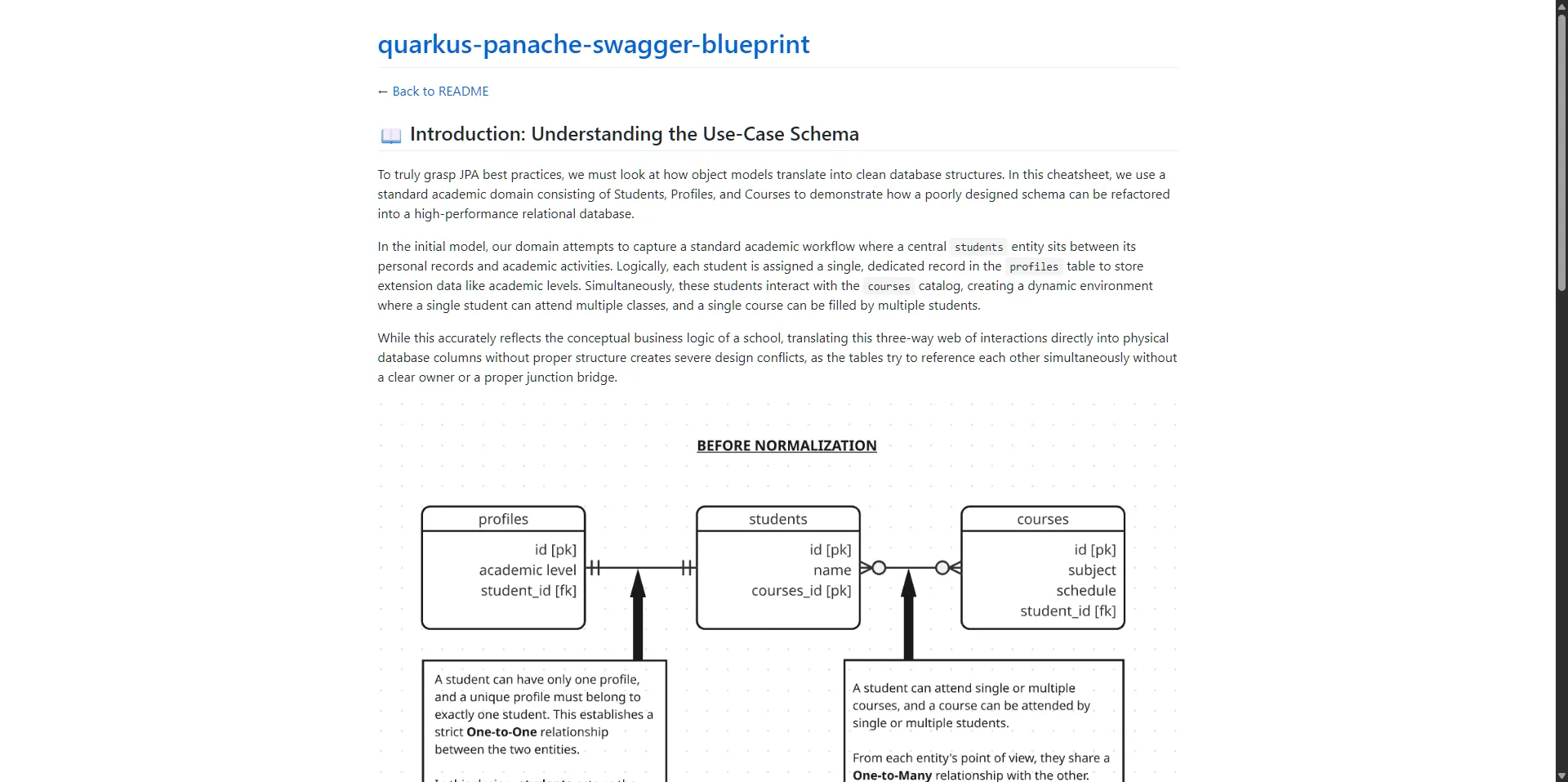
The use-case domain is a standard academic schema: Student, Profile (1:1 shared PK), Course, and Enrollment (M:M junction), small enough to hold in your head, but covers all three relation types you’ll encounter in real databases.
Technologies
- Quarkus (REST Data Panache, Hibernate ORM Panache, Hibernate Validator, SmallRye OpenAPI)
- Jakarta JPA / Hibernate
- Jackson (JSON serialization)
- MicroProfile OpenAPI (OASFilter)
- H2 (development), configurable for PostgreSQL/MySQL in production
- JUnit 5 + REST Assured (integration tests)
How I Built It
The starting point was a frustration I kept running into: Quarkus REST Data Panache is genuinely fast for prototyping, but every time I used it in a service with real entity relationships, I’d end up either debugging silent N+1 queries, rewriting endpoints that didn’t handle shared primary keys, or explaining to teammates why the Swagger docs showed status codes that never actually appeared.
The obvious fix, “just don’t use PanacheEntityResource”, felt like the wrong answer. The generated CRUD is fast to stand up and genuinely useful for the cases it handles well. The problem wasn’t the tool; it was the lack of a pattern for using it correctly in a constrained scope.
So I defined the constraint first: a database wrapper microservice. A service that owns a few tables, exposes them over REST, and doesn’t carry business logic. That’s exactly the use case where auto-generated CRUD pays off the most, and where the specific failure modes are predictable enough to document and fix systematically.
From there, every decision followed from that constraint:
- Unidirectional relationships only, the parent doesn’t need to know about the child in a service where each resource exposes its own data independently.
@JsonIgnoreon relation fields + custom getter/setter, the only reliable way to prevent lazy proxy initialization through auto-generated serialization, while still exposing flat FK ids in the request/response body.getReference()for shared-PK inserts, avoids an unnecessarySELECTagainst the parent table when only the FK value is needed to satisfy@MapsId.- OASFilter at startup, corrects the OpenAPI spec generated by REST Data Panache to document what the API actually does, not what the generator assumes.
- No exception mapper, intentionally left out. Error handling conventions vary by team and company; a template that prescribes one creates more friction than it removes. The template documents where raw errors surface and what they look like, so adopters know exactly where to wire in their own handling.
The N+1 demonstration was added specifically because “this causes extra queries” is easy to say and hard to believe until you see it. Two endpoints, same response shape, measurably different behavior, that’s more convincing than any amount of explanation.
The Product
The deliverable is a working Quarkus project with a Swagger UI that’s actually usable for testing, request bodies are pre-shaped correctly, and the documented status codes reflect what the endpoints actually return.
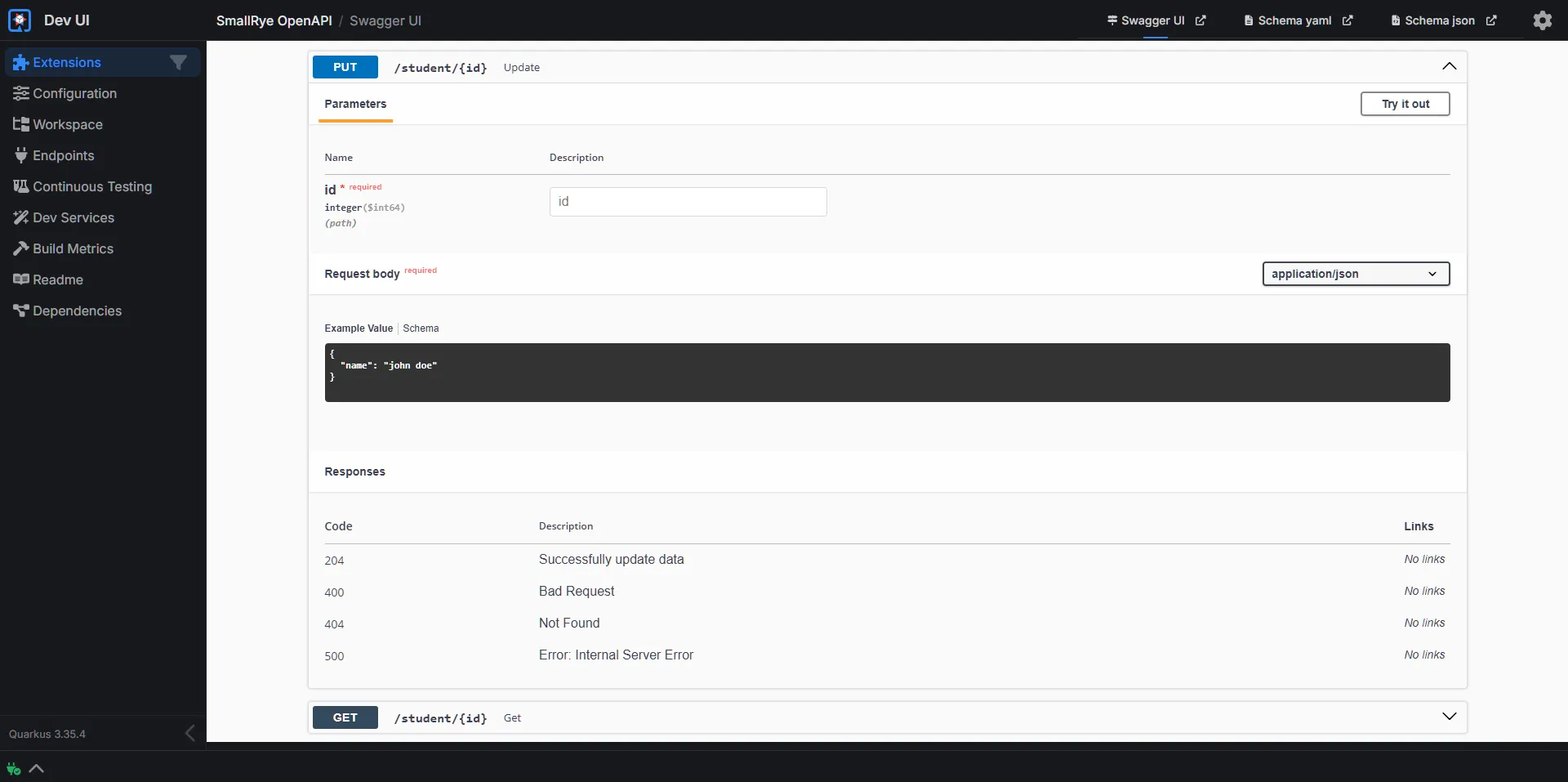
Example: PUT /student
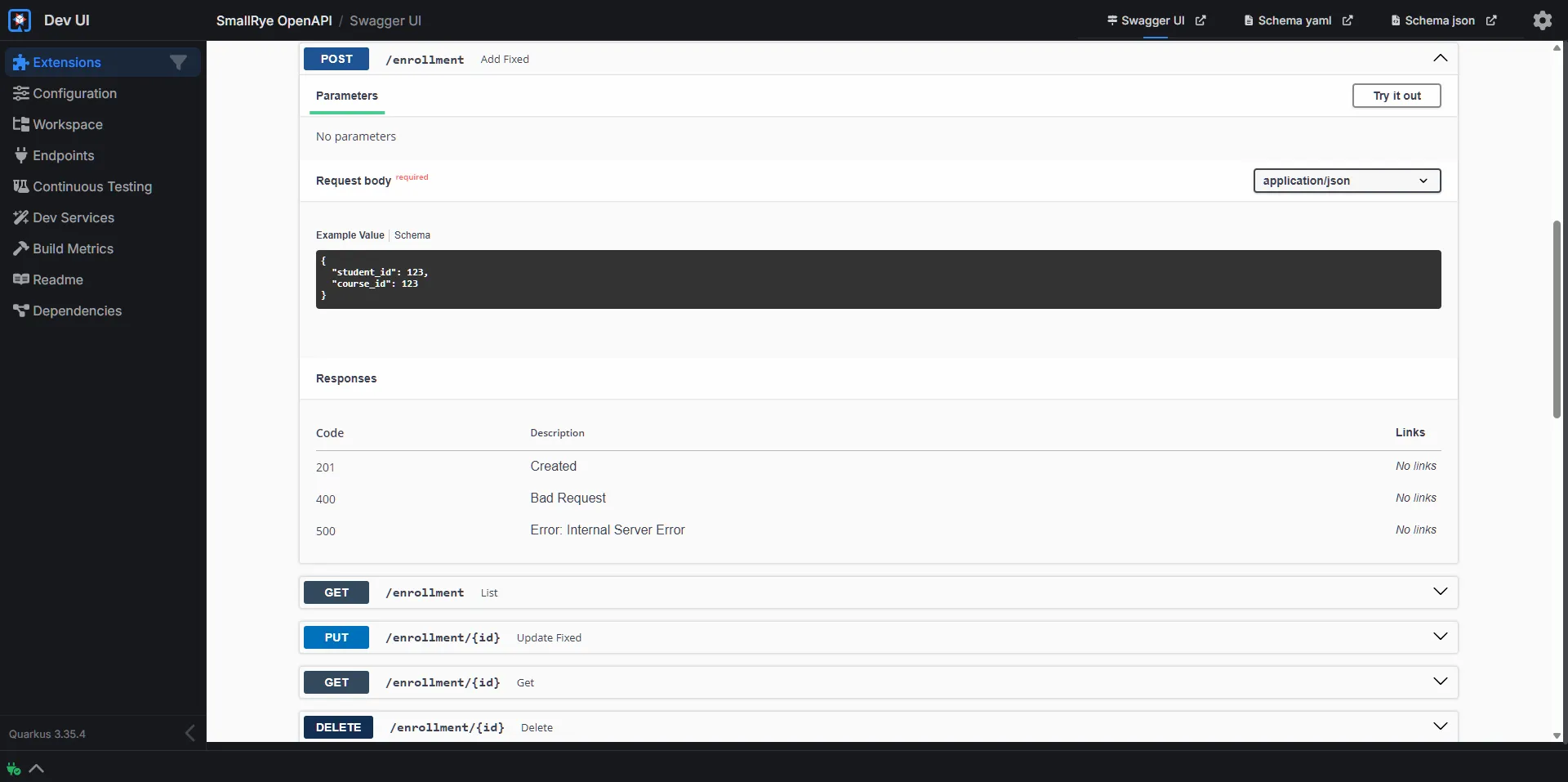
Example: POST /enrollment request body
student.id and course.id presented as flat Long student_id and course_id in payload, not nested object
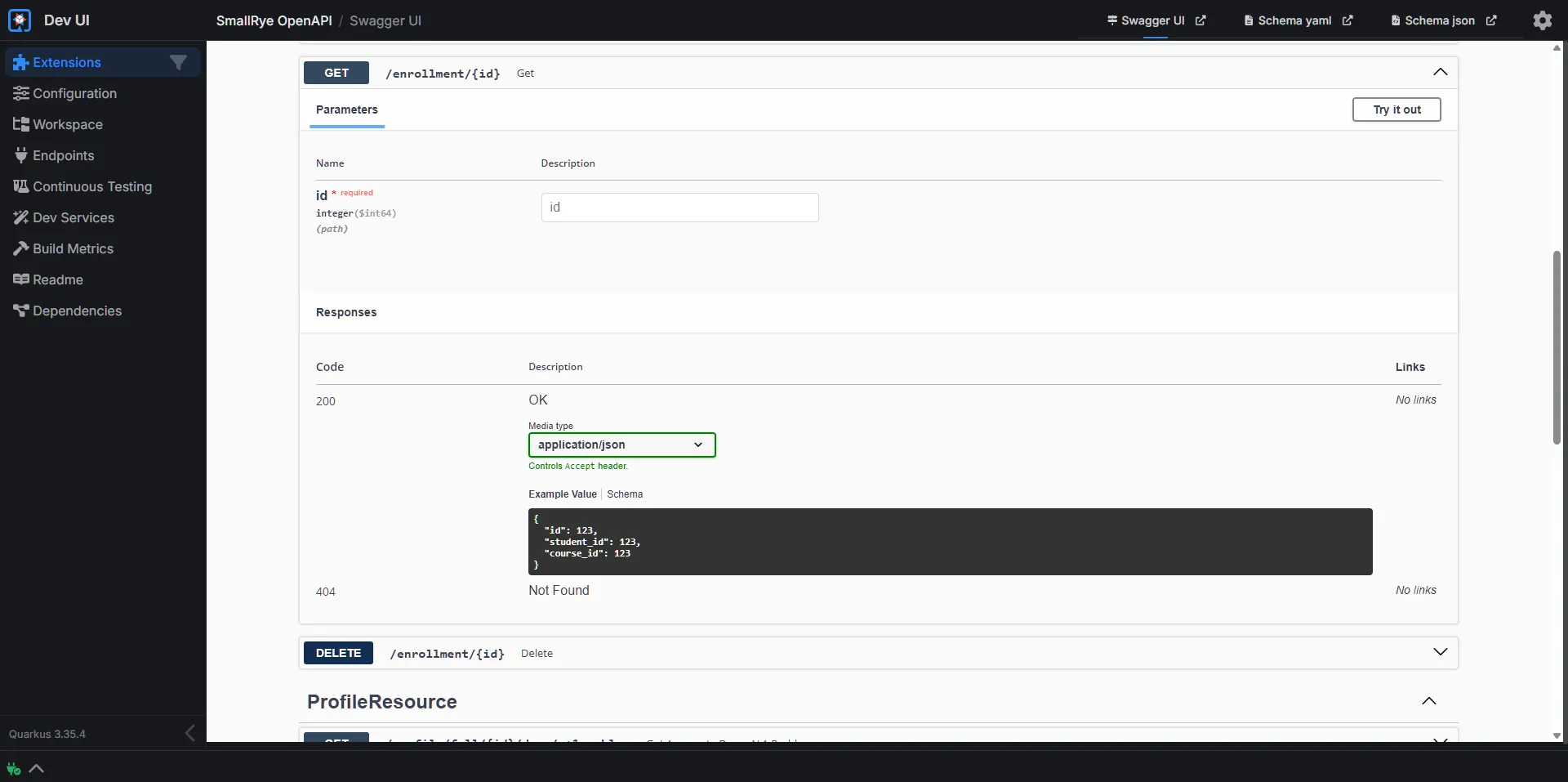
Example: GET /enrollment/{id} response body body
student.id and course.id presented as flat Long student_id and course_id in payload, not nested object
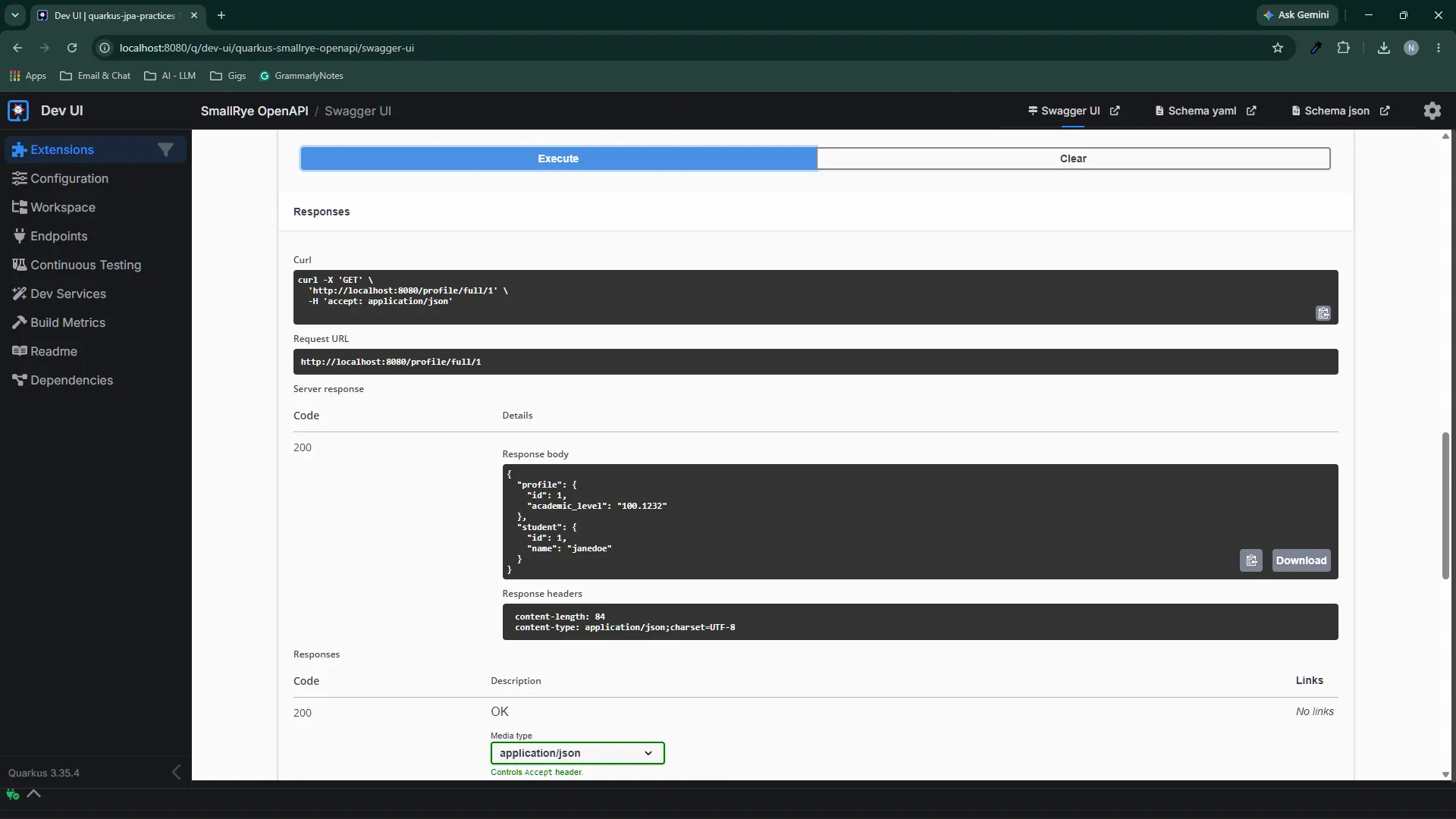
Besides providing reusable template with optimized auto-generated swagger, it also provides demonstration the N+1 problem, and how to avoid it. It provides two demo endpoints with the same response shape, same DTO, but one quietly fires an extra query per request and one doesn’t, that you can try on your own when using this template project.
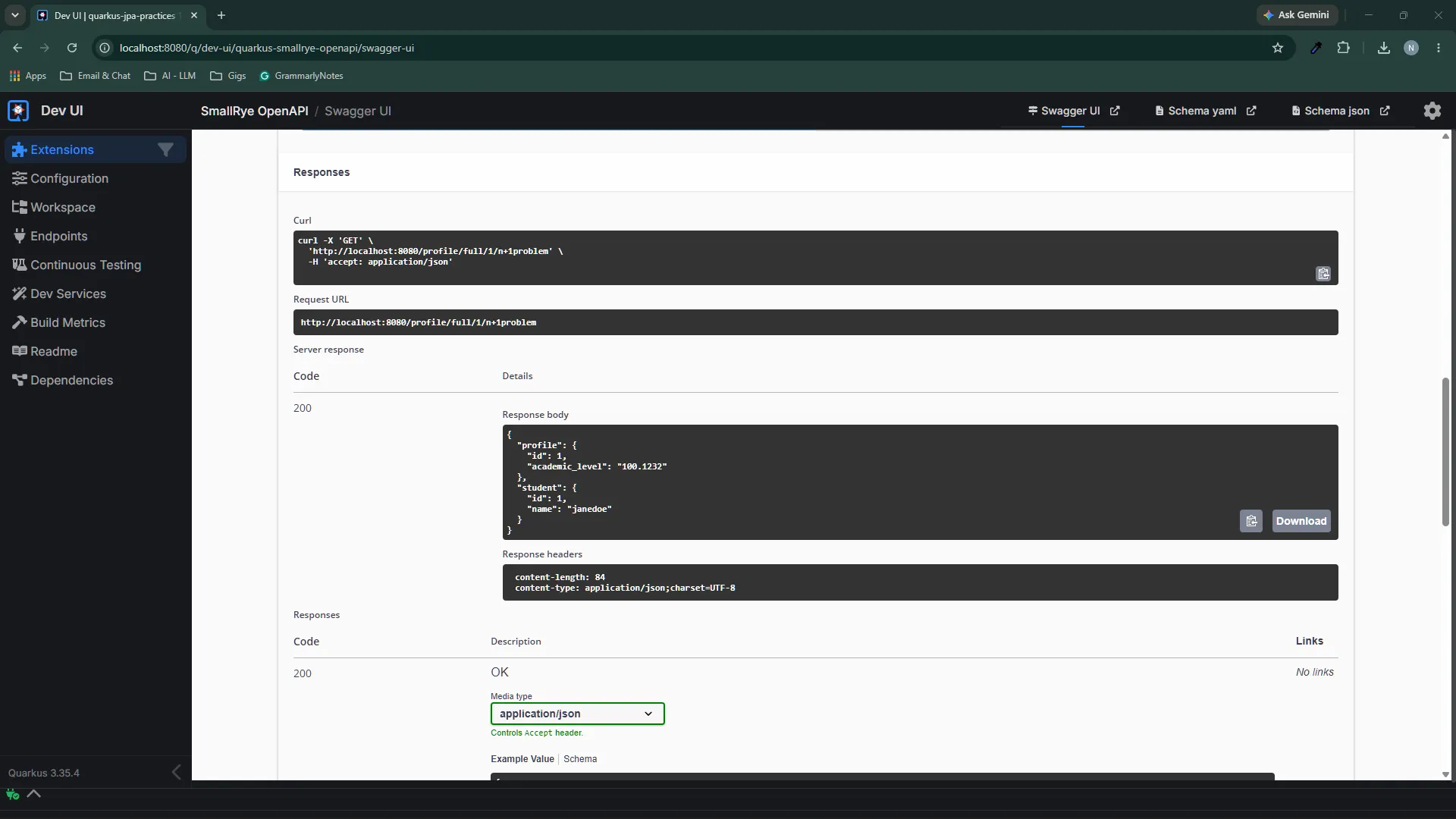
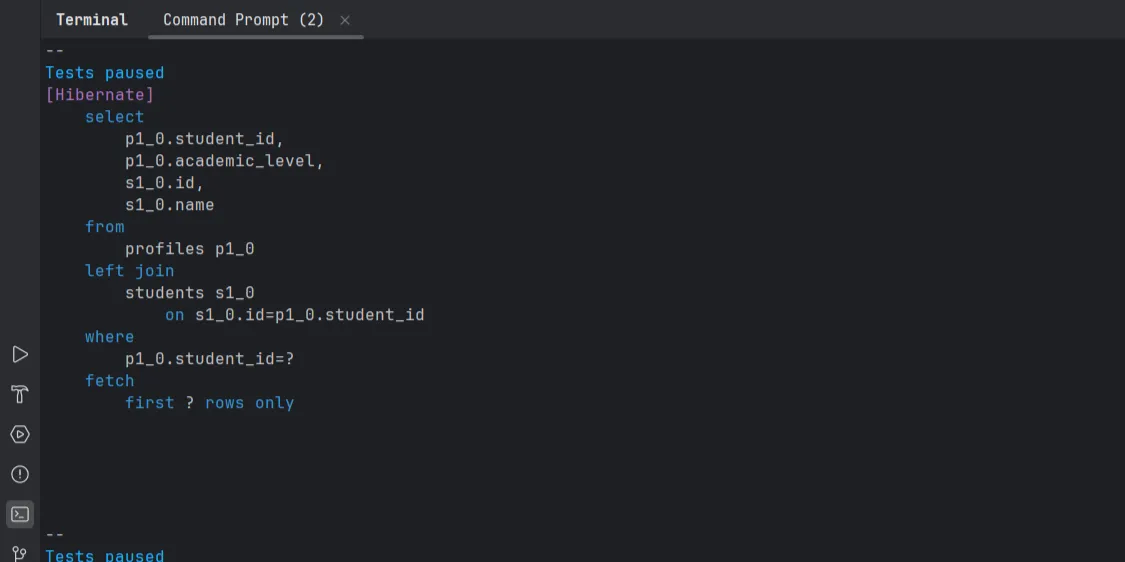
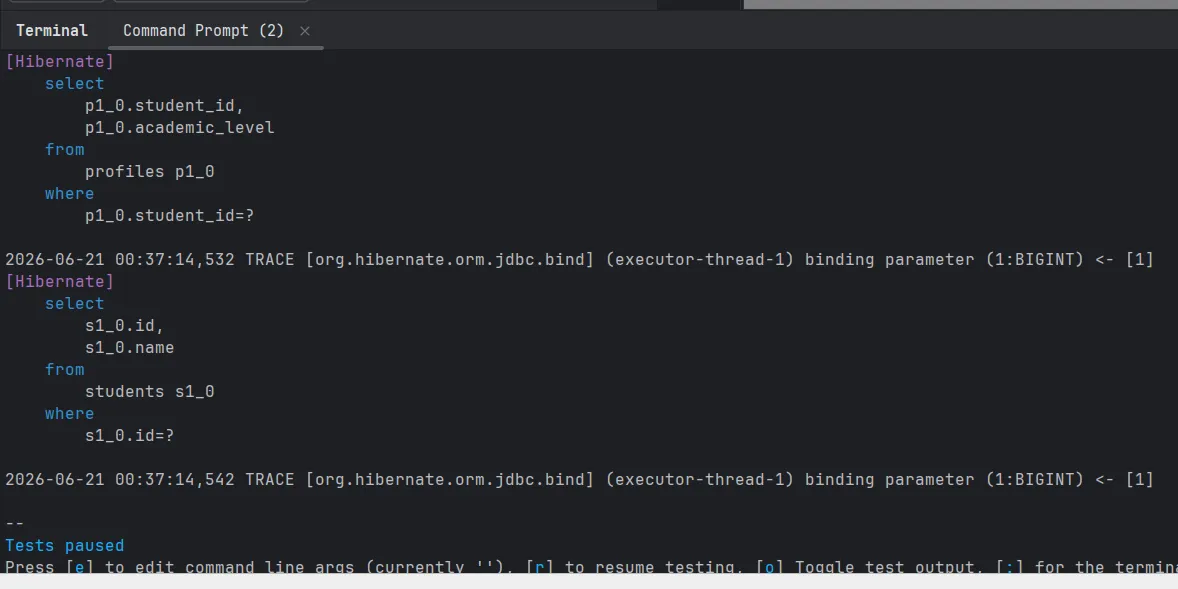
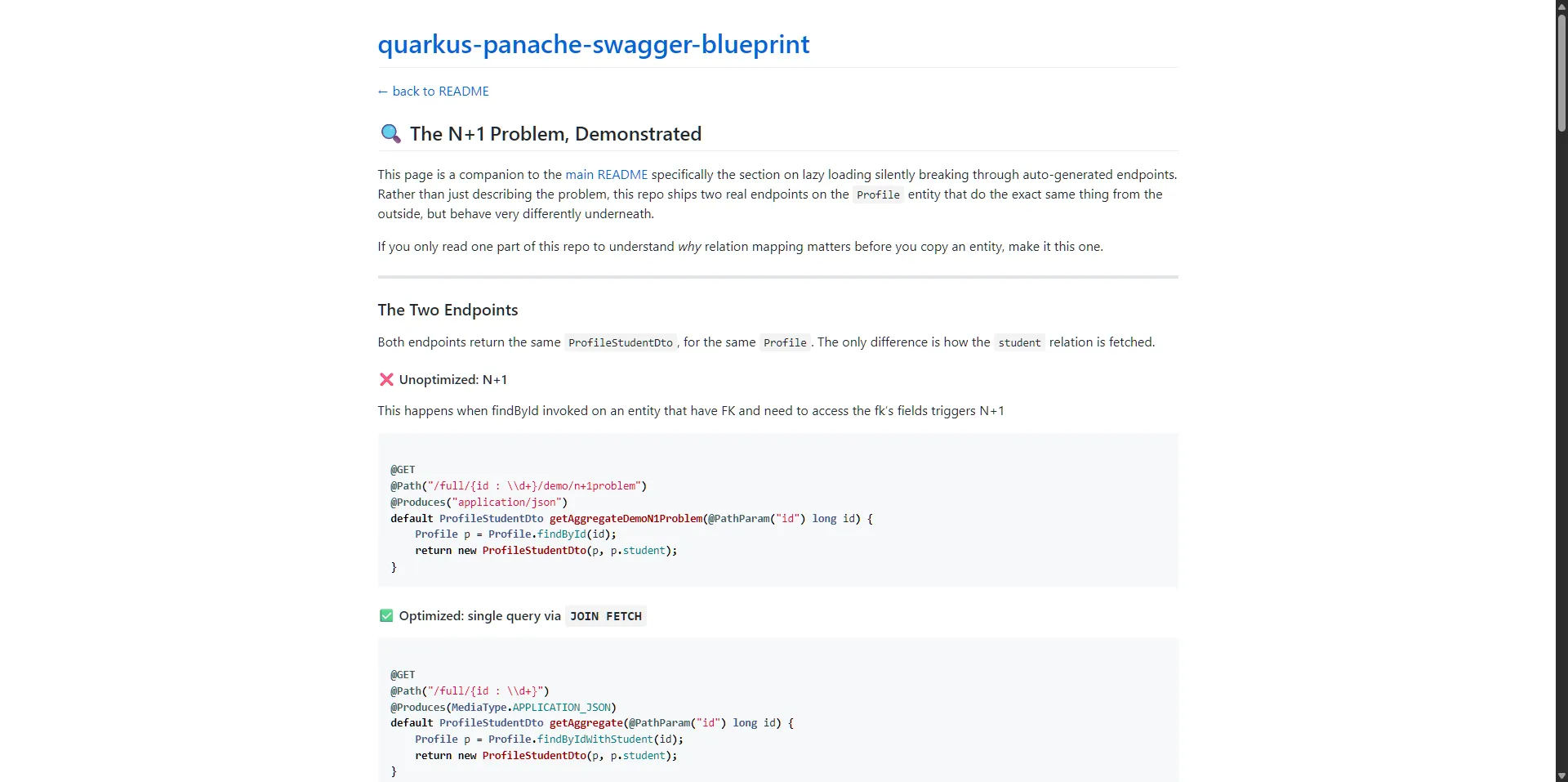
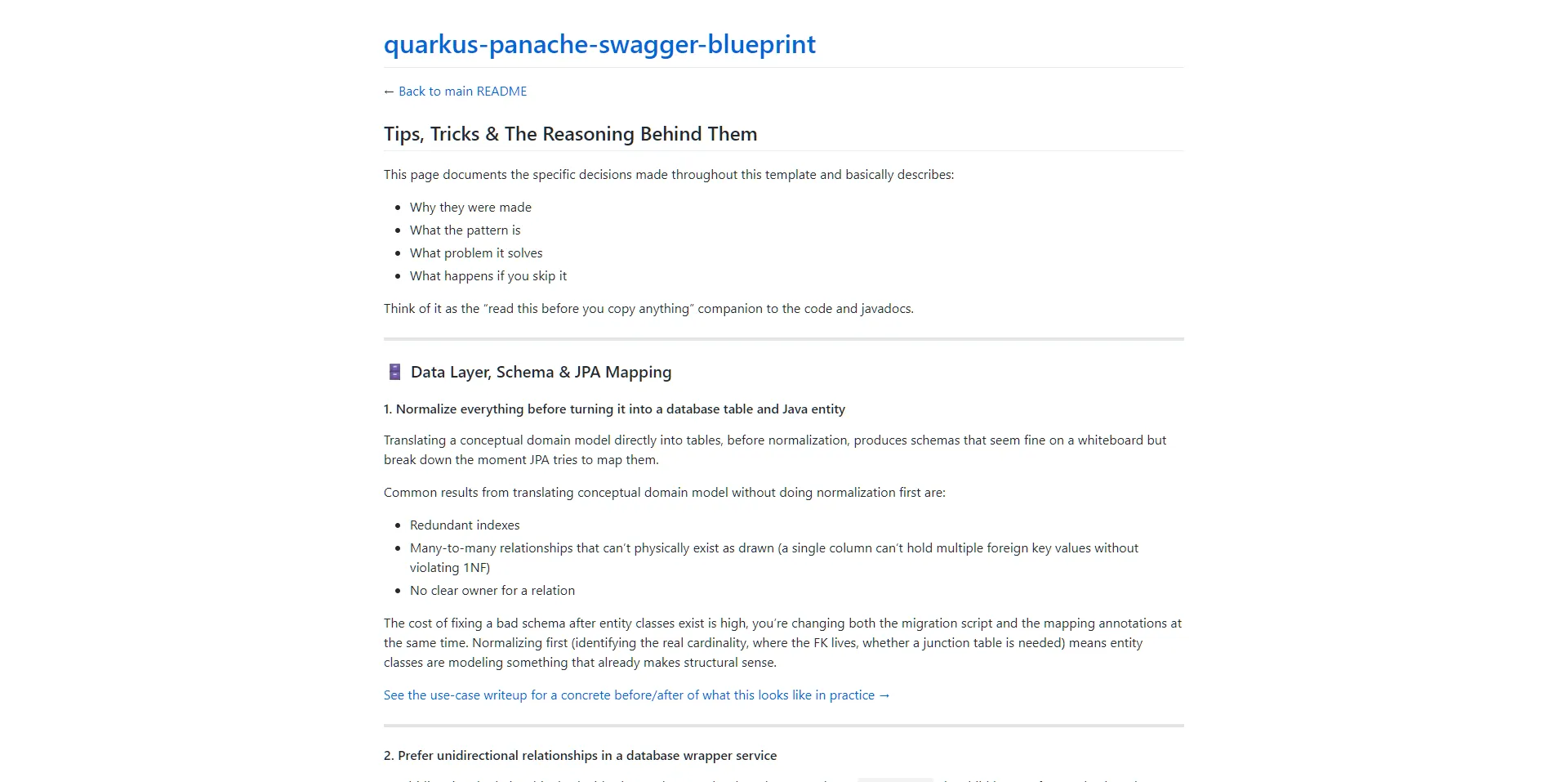
The deliverable also includes a comprehensive README with the technical reasoning behind every decision made to create this blueprint.
Challenges
- REST Data Panache’s generated endpoints behave differently depending on the entity’s relation type, the failure modes for shared-PK entities, FK-constrained entities, and lazy-loaded relations are each distinct and need separate fixes.
- Java record fields annotated with
@NotNullalone don’t cascade Bean Validation into nested objects,@Validis also required, and the distinction isn’t obvious from the annotation names. @JsonIgnoreon a relation field prevents lazy loading issues but introduces a different problem: how to expose the FK id in the request/response body without the full nested object. Solved via custom getter/setter pairs that Jackson treats as a named property.- OASFilter requires knowing the Quarkus-specific filter lifecycle,
RunStage.RUNTIME_STARTUPvs build-time, and understanding that status code correction needs to happen after REST Data Panache has generated the initial spec.
Solutions
- Documented each failure mode with its root cause, not just the fix, so adopters understand when to apply a pattern, not just how.
- Used
@NotNull @Validtogether on record fields to enable cascading validation into nested entity constraints. - Implemented custom getter/setter pairs on the owning side of lazy relations, keeping the relation field
@JsonIgnorewhile exposing flat FK ids as named JSON properties through Jackson’s property accessor convention. - Separated OASFilter (path-matching, endpoint list) from OASFilterHelperPanache (per-HTTP-method correction logic) so each can grow independently without coupling.
Lessons Learned
The most useful thing this project clarified isn’t a Quarkus-specific trick, it’s a broader principle about templates and boilerplate: the value isn’t in what you include, it’s in what you decide not to include and why.
Every “missing” thing in this template (exception mapper, API versioning, business logic, complex cascades) is missing for a specific reason tied to the scope. Documenting those reasons, in the README, in the cheatsheet, in the javadocs, is what makes the difference between a template someone clones and discards, and one they actually understand well enough to extend.
The other thing I’d take forward: when auto-generated code fails silently (no exception, just wrong behavior), the failure mode is almost always about when something happens relative to the Hibernate session lifecycle. That mental model, “is the session still open? is the proxy initialized? is this being read during serialization or during a transaction?”, is more useful than any specific fix.